
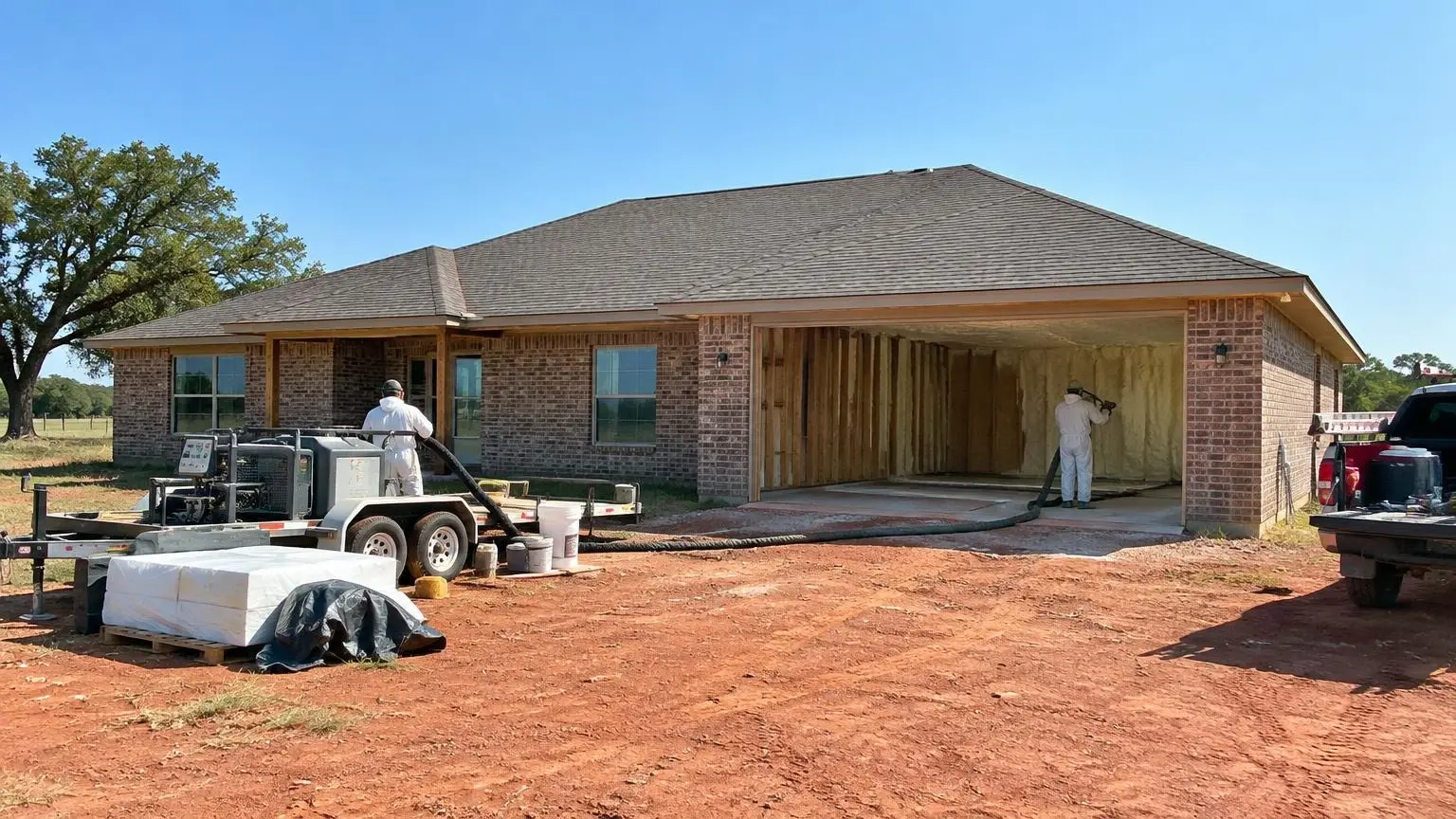
Open cell or closed cell, picked for each surface
Spray Foam Insulation in Oklahoma City, OK
Air sealing and insulation in a single layer, for houses, additions and outbuildings around the metro.
- Free on-site estimates
- Written quote listing material, thickness and R-value for each area
- Attic leaks, ducts and roof stains checked before anything is covered
One Layer That Seals and Insulates
Spray foam insulation is a two-part liquid that expands as it is sprayed, sticks to the surface and cures into a solid layer. Because it fills every gap it touches, it insulates and air seals in one step, which batts and loose fill cannot do on their own. In Oklahoma City homes that matters most in places where air leaks are hard to reach with caulk and sealant: the underside of a roof deck, the joint where walls meet the top plate, the floor of a room over a garage, and the long seams of a metal building.
Open-cell foam
Open-cell foam is light and spongy, expanding many times its liquid volume. HomeGuide lists it at about R-3.5 to R-3.7 per inch and $1.50 to $3.50 per square foot installed. It stops air well and deadens sound, but some water vapor still passes through it. In central Oklahoma it is often used on the underside of the roof deck in new houses, which turns the attic into a sealed, semi-conditioned space so the air handler and ducts are no longer baking in a vented attic, and in interior walls and floors where sound matters.
Closed-cell foam
Closed-cell foam is dense and rigid, at roughly R-5 to R-7 per inch and $3.00 to $5.00 per square foot in HomeGuide's 2026 figures. At typical thickness it acts as a vapor retarder, does not hold water and stiffens the surface it is bonded to. We use it on steel buildings and barndominiums, on garage ceilings under bedrooms, on band areas between floors, and anywhere space is tight and each inch has to count.
Who it suits
Spray foam is a good fit when you are building or adding on and the framing is open, when you have a metal building that sweats or bakes, when your HVAC equipment lives in the attic and you want it inside the thermal envelope, or when a room over a garage or a bonus room with kneewalls never feels right. It is a weaker fit on a wide, open attic floor in an existing house, where air sealing plus blown-in fill usually costs less per unit of R-value. We will tell you which side of that line your house falls on.
Signs it is worth a look
Upstairs rooms that run several degrees warmer than the ground floor in summer. An AC that runs nearly nonstop on 100-degree days. A bonus room over the garage that is hot in July and cold in January. Dust streaks on carpet along baseboards, which often mark air leaks. A metal roof or wall that drips on cool mornings. Any of those is a reason to have someone look at where the air and heat are getting in.
Sealing an attic changes the house
When foam goes on the roof deck, the attic is no longer vented to the outdoors. That can make ducts and equipment much more efficient, but it also means attic vents get closed off, any gas appliance up there needs a proper air supply and venting, and the space should get a small amount of conditioning or air exchange. We explain those details before you choose, not after. Get a free estimate
What This Covers
Where we spray foam on metro homes and buildings.
Roof deck (sealed attic)
Open-cell or closed-cell foam on the underside of the roof so the attic, ducts and air handler sit inside the insulated space.
New construction walls
Foam in open stud bays before drywall, sealing outlets, top plates and sill plates as it insulates.
Garage ceilings and bonus rooms
Closed-cell foam in the floor framing of rooms over garages, which also helps block garage fumes.
Kneewalls and band areas
Foam on kneewalls, sloped ceilings and the band between floors, where batts tend to fall short.
Additions and sunrooms
Foam in walls and ceilings of new additions so they match the comfort of the main house.

Published Spray Foam Insulation Costs
| Job | Range and source |
|---|---|
| Spray foam, installed | $1.50 to $5.00 per sq ft (HomeGuide) |
| Open-cell / closed-cell | $1.50 to $3.50 / $3.00 to $5.00 per sq ft (HomeGuide) |
| About 1,000 sq ft | $1,500 to $5,000 (HomeGuide); $3,150 to $7,500 existing home (Fixr) |
| Existing walls / new construction | $3.15 to $7.50 / $2.75 to $6.50 per sq ft (Fixr) |
| Spray foam on the roof deck | $1,500 to $9,000 (HomeGuide) |
| Whole house | $8,000 to $20,000 (HomeGuide); $10,000 to $30,000 (Fixr) |
| Typical job minimum | $1,000 to $2,000+ (HomeGuide) |
National ranges from HomeGuide's 2026 spray foam guide and Fixr's 2025 figures. Foam type, thickness, access and prep work set the real total, and small jobs often land on a minimum. You pay the number on your written estimate, not a number from a chart.
How a Spray Foam Job Goes
1. Visit and measure
We look at the spaces, measure areas and depths, check the ducts, wiring and roof, and talk about how you use each room.
2. Written quote
You get each area listed with foam type, thickness, R-value and price, plus any alternatives that would also work.
3. Prep and spray
We cover floors and belongings, mask what must stay clean, set up ventilation and apply the foam in passes to the planned thickness.
4. Trim and clean up
Overspray and excess foam get trimmed where needed, debris is hauled out and the work area is cleaned.
5. Re-entry and walk-through
After the curing period you return to the house, and we walk the job with you and point out what was done.

Spray Foam Insulation Questions
How long do I need to stay out of the house after spray foam?
HomeGuide advises staying out for at least 24 hours after spraying. The exact time depends on the product and how much was applied, and we tell you before the job is scheduled.
Will spray foam on my roof deck hide a roof leak?
It can make a leak harder to spot, which is why we check the decking and look for stains before we spray. Any active leak should be repaired first.
Can spray foam go into existing finished walls?
Standard spray foam needs open framing. For finished walls, the usual options are dense-packed cellulose or an injection foam through small holes, which we cover on our wall insulation page.
Does spray foam help with dust and pollen?
Sealing the gaps where outside air leaks in reduces how much dust and pollen gets pulled inside. It is not a substitute for good filtration on the HVAC system.
Is spray foam worth it for an older Oklahoma City house?
Sometimes. If the ducts are in the attic, or there are rooms over the garage or kneewalls, foam often makes sense. If the attic floor is open and easy to reach, sealing plus blown-in may give you more for the money. We price both when both could work.
Spray Foam Insulation Service Areas
- Spray Foam Insulation in Oklahoma City, OK
- Spray Foam Insulation in Edmond, OK
- Spray Foam Insulation in Norman, OK
- Spray Foam Insulation in Moore, OK
- Spray Foam Insulation in Midwest City, OK
- Spray Foam Insulation in Del City, OK
- Spray Foam Insulation in Yukon, OK
- Spray Foam Insulation in Mustang, OK
- Spray Foam Insulation in Bethany, OK
- Spray Foam Insulation in Warr Acres, OK
- Spray Foam Insulation in Nichols Hills, OK
- Spray Foam Insulation in The Village, OK
- Spray Foam Insulation in Choctaw, OK
- Spray Foam Insulation in Harrah, OK
- Spray Foam Insulation in Piedmont, OK
- Spray Foam Insulation in Newcastle, OK
- Spray Foam Insulation in Blanchard, OK
- Spray Foam Insulation in Tuttle, OK
- Spray Foam Insulation in Guthrie, OK
- Spray Foam Insulation in El Reno, OK
- Spray Foam Insulation in Noble, OK
Get a Spray Foam Insulation Estimate
We look at the space and recommend open cell, closed cell or something else, in writing.